Choosing between mini pleat and traditional aluminum separator HEPA filters depends on space constraints, operating temperatures, and humidity; mini pleats offer compact profiles and low weight using hot-melt separators, whereas aluminum separator filters provide superior durability in high-temperature (up to 350°C) and high-humidity environments.
The fundamental difference between mini pleat HEPA filters and traditional deep-pleat separator HEPA filters lies in their internal structure, specifically how the filter media is folded and held in place.
Mini pleat filters represent the modern evolution of HEPA design. They use very thin glass fiber media folded into tightly packed, shallow pleats (typically 20mm to 50mm in height). * Separation Mechanism: Instead of corrugated sheets, mini pleat filters use continuous beads of thermoplastic hot-melt glue (adhesive lines) spaced at precise intervals. These glue beads act as separators, keeping the media pleats open and maintaining a uniform, narrow distance between folds. * Media Density: By eliminating physical aluminum or paper separators, a much higher density of pleats can be packed into a smaller frame depth. This maximizes the active media surface area relative to the overall thickness of the filter, allowing for ultra-slim frame profiles (as thin as 50mm to 90mm).
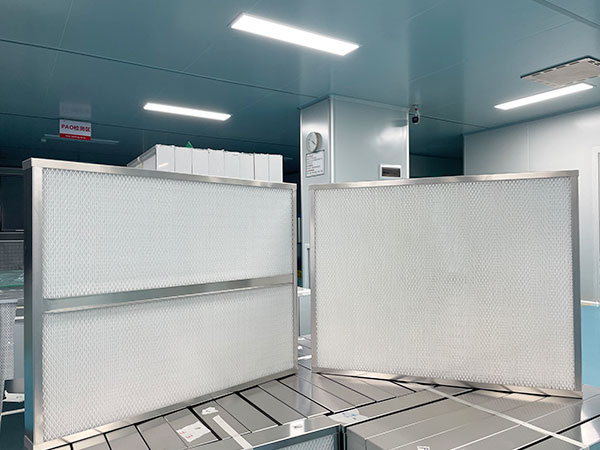
Separator HEPA filters are the classic deep-pleat design. The glass fiber media is folded in deep, alternating folds across the entire depth of the filter frame (typically 150mm to 292mm deep). * Separation Mechanism: To keep these deep pleats separated and prevent the media from collapsing under airflow pressure, corrugated separators are inserted between each fold. These separators are typically made from ultra-thin corrugated aluminum foil or specialty moisture-resistant paper. * Media Spacing: The corrugated pattern creates uniform, wide air channels across the entire depth of the filter, facilitating highly uniform laminar airflow and high mechanical stability.
Understanding the performance metrics of both filter types is crucial for making the correct specification during the HVAC design phase.
|
Technical Parameter |
Mini Pleat HEPA Filter |
Separator (Deep Pleat) HEPA Filter |
|
Typical Frame Depth |
50 mm, 69 mm, 90 mm, 120 mm |
150 mm, 220 mm, 292 mm |
|
Separation Method |
Thermoplastic Hot-Melt Glue Beads |
Corrugated Aluminum Foil or Kraft Paper |
|
Media Pleat Height |
20 mm to 50 mm |
100 mm to 280 mm |
|
Initial Pressure Drop |
Low (typically ~80 to 120 Pa at standard velocity) |
Moderate (typically ~180 to 250 Pa at standard velocity) |
|
Dust Holding Capacity |
High (due to high density of pleats) |
Very High (due to deeper media volume) |
|
Physical Weight |
Light (typically 30% to 50% lighter than separator type) |
Heavy (due to aluminum separators and deep frame) |
|
Maximum Humidity Resistance |
up to 100% RH (specialty glue) |
up to 100% RH (with corrugated aluminum foil) |
|
Maximum Operating Temp |
Up to 80°C |
Up to 350°C (with SUS frame and inorganic sealant) |
|
Laminar Airflow Uniformity |
Very Good (small deviations) |
Excellent (corrugated channels align airflow perfectly) |
|
Structural Rigidity |
Moderate (frame-dependent) |
Very High (metal separators reinforce the media pack) |
|
Cost Index |
High initial cost (specialized automation assembly) |
Moderate (established deep-pleat production) |
While mini pleat filters are increasingly popular, separator HEPA filters remain irreplaceable in several key industrial environments:
Ultra-High Temperature Environments: In high-temperature drying ovens or pharmaceutical depyrogenation tunnels (operating at 250°C to 350°C), hot-melt glue will melt and catch fire. Separator filters utilizing corrugated aluminum foil and stainless steel frames are the only viable option.
High Humidity and Steam Exposure: In livestock research, biological cleanrooms, and food processing facilities subjected to regular vaporized hydrogen peroxide (VHP) sterilization or steam cleaning, aluminum separator filters provide the necessary physical rigidity to resist moisture sagging and media tearing.
High Airflow Volumes and Large Systems: In heavy-duty Air Handling Units (AHUs) handling high face velocities, deep-pleat separator filters offer greater mechanical strength, preventing pleat flutter and ensuring uniform pressure distribution.
For most modern cleanroom systems, mini pleat HEPA filters have become the industry standard:
Space-Constrained Installations: Mini pleats allow Fan Filter Units (FFUs) to have profiles as slim as 150mm overall, saving vital ceiling plenum space in modern semiconductors and electronics manufacturing cleanrooms.
Ceiling Grid Integration: Due to their lightweight design, mini pleat filters are far easier to install in ceiling grids, reducing the structural load-bearing requirements of the cleanroom ceiling suspension system.
Energy Efficiency and Operating Cost: The low initial resistance of mini pleat filters reduces the electrical power consumption of the FFU blowers, translating to significant long-term energy savings in large-scale cleanrooms.
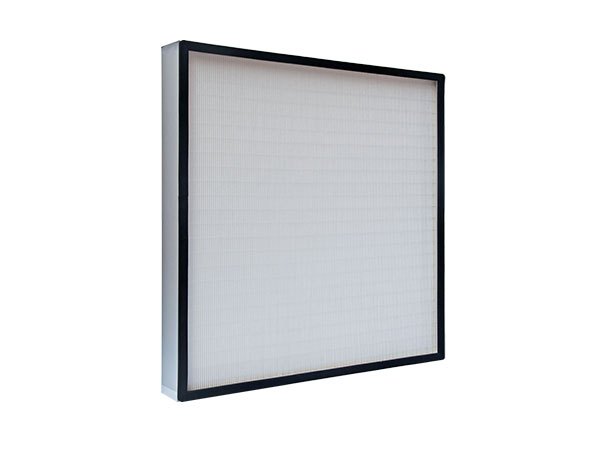
As an established mini pleat HEPA filter manufacturer, KLC offers a comprehensive range of both types. The KLC Mini-pleat HEPA Filter series features ultra-thin glass fiber media with computer-controlled hot-melt glue bead spacing, providing high-efficiency (up to H14) in compact, lightweight 50mm, 69mm, and 90mm anodized aluminum frames. For deep-pleat applications, the KLC Separator HEPA Filter series integrates high-grade corrugated aluminum separators with folded edges to prevent media damage, ensuring reliable performance in high-humidity or high-temperature environments.
Mini pleat filters feature a higher pleat density, which pack more square meters of filter media into a given face area compared to separator filters. This increased media area reduces the face velocity of the air as it passes through the media fibers, resulting in a lower initial pressure drop and reduced fan power consumption.
In low-quality separator filters, the sharp edges of the corrugated aluminum foil can cut or scratch the fragile glass fiber media during transportation or under high vibration. However, professional manufacturers like KLC use specialized hemmed or folded-edge aluminum separators to eliminate sharp edges, completely preventing media damage.
Mini pleat filters are far better suited for cleanroom ceiling grids and Fan Filter Units (FFUs). Their lightweight construction (typically 50% lighter than separator filters of the same face area) and shallow frame depths (50mm to 90mm) make installation safer, easier, and much less demanding on the ceiling structural support.
Deep-pleat separator filters generally have a larger total volume of media per unit, allowing them to accumulate a larger mass of heavy dust before reaching terminal pressure drop. Mini pleat filters have high surface area but smaller physical volume, making them ideal for clean cleanroom supply air where pre-filtration has already removed larger particles.
No. Standard hot-melt glue separators are made of thermoplastic resins that soften at temperatures above 60°C and melt completely at 80°C to 120°C. For any application exceeding 80°C, mini pleat filters with hot-melt separators must be avoided in favor of aluminum separator filters with high-temperature glass fiber or ceramic seals.
The standard nominal face velocity for both mini pleat and separator HEPA filters is typically 0.45 m/s (90 fpm), which is the standard velocity required to maintain laminar airflow in cleanrooms. However, separator filters are capable of handling higher air velocities (up to 1.5 m/s in some HVAC designs) with a corresponding increase in pressure drop.
Moisture-resistant paper separators can handle standard humidity levels up to 80% RH. However, continuous high humidity or condensation will cause paper separators to absorb water, soften, and lose their corrugated structure, causing the filter pleats to collapse. For highly humid environments, aluminum separators should always be selected.
Mini pleat filters eliminate the dense metal sheets used as aluminum separators and feature compact, thin-walled anodized aluminum frames. This lightweight design reduces installation time, minimizes the risk of workers dropping filters during high-ceiling assembly, and reduces overseas shipping and logistical costs significantly.
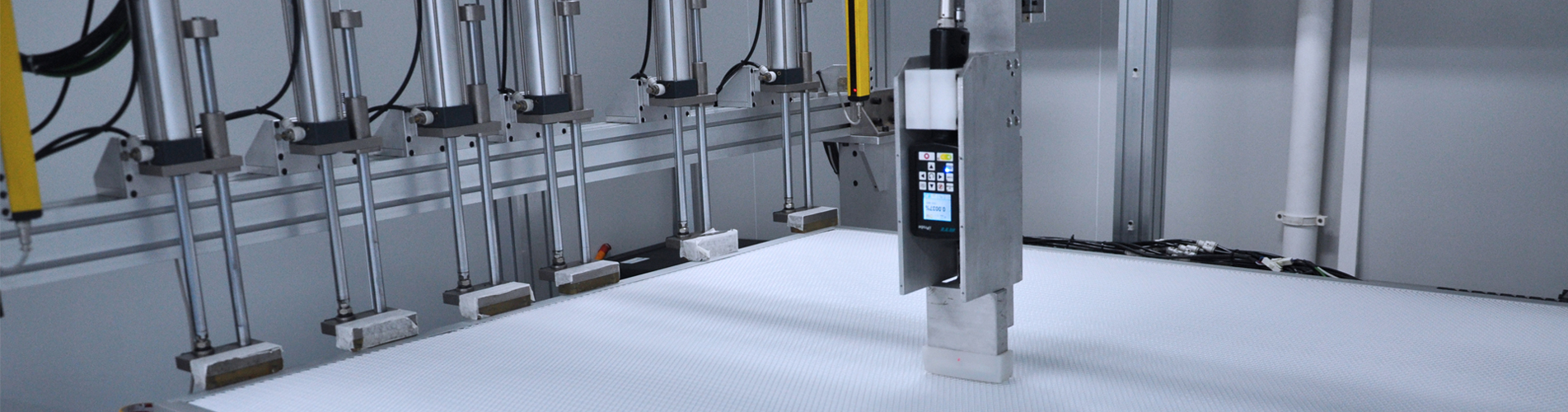
Yes, both mini pleat and separator filters can and should be leak scanned using a photometer or discrete particle counter (the DOP/PAO test). However, mini pleat filters are slightly easier to scan on automatic lines because their flat, shallow face allows the scanning probe to pass closely and uniformly across the entire media surface.
The choice of depth is dictated by your Air Handling Unit (AHU) or FFU housing design. If your housing is built for deep-pleat filters (typically 150mm to 292mm), installing a 50mm mini pleat filter will require custom adapters. Always match the filter depth to the housing frame specifications to ensure a hermetic seal.
Selecting the correct HEPA filter design involves balancing space limitations, operating conditions, and lifetime energy costs. Mini pleat filters excel in standard modular cleanrooms and modern FFUs, while separator filters remain the standard for high-temperature and high-humidity industrial processes. To discover the ideal filtration configuration for your cleanroom system and review complete performance datasheets, visit KLC International at https://www.klcintl.com/.



 IPv6 network supported