According to industry audits, over 70% of microbial contamination in pharmaceutical “Grade A” zones is introduced by personnel. While the air shower is the primary gateway for decontamination, many facilities are still using hardware that inadvertently harbors the very pathogens they aim to exclude. In an industry where a single batch failure can cost upwards of $500,000, the “standard” industrial air shower is no longer a cost-saving measure—it is a risk.
In a sterile pharmaceutical environment, the design of an air shower is not just about airflow; it is about material integrity, surface energy, and cleanability. Standard powder-coated steel units, common in general manufacturing, are a significant liability in a GMP-compliant facility. Over time, the aggressive cleaning agents used in pharma—such as sodium hypochlorite or hydrogen peroxide—cause powder coating to chip, flake, and crack. These microscopic fissures create the perfect anaerobic environment for bioburden to thrive, protected from subsequent surface wipes.
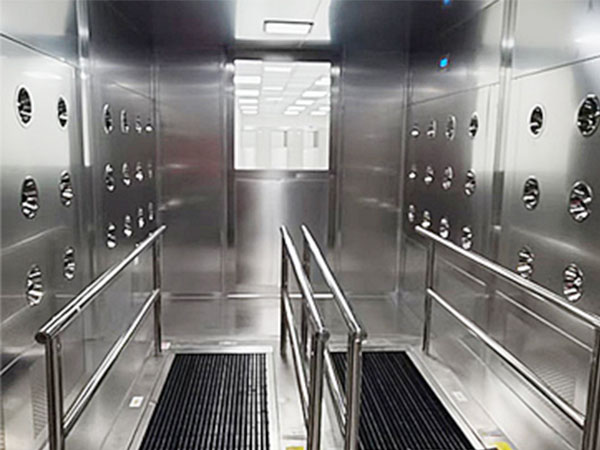
For pharmaceutical applications, the internal surfaces of an air shower must be constructed from Stainless Steel 316L. While SS304 is often touted as “stainless,” it lacks the molybdenum content required to resist pitting corrosion from the chlorides found in many sterilants. 316L provides that essential barrier.
Furthermore, “radius corners” (coved corners) are essential for any unit positioned between Grade B and Grade A zones. Sharp 90-degree angles are impossible to wipe down effectively, leading to “dead zones” where skin squames and microbial spores can accumulate. A true pharmaceutical air shower features a fully welded, mirror-polished interior with coved base-to-wall and wall-to-ceiling transitions.
While H13 HEPA filters are standard for many cleanrooms, aseptic pharmaceutical zones increasingly demand H14, as defined by the EN1822 standard. The difference might seem marginal on paper, but in terms of particle penetration at the Most Penetrating Particle Size (MPPS), it is an order of magnitude.
|
Filter Class |
Efficiency at MPPS |
Max Penetration |
Test Standard |
|
HEPA H13 |
99.95% |
0.05% |
EN1822 |
|
HEPA H14 |
99.995% |
0.005% |
EN1822 |
By upgrading to H14, you are reducing the allowable particle penetration by a factor of 10. In a field where a single CFU (Colony Forming Unit) can lead to a total batch rejection and a mandatory “clean-room shutdown” for investigation, this margin of safety is a fundamental requirement of risk management.
We recently consulted for a facility that failed a sterile audit because of “crevice contamination” within their air shower. The unit, though stainless steel, used standard industrial hinges and exposed screw heads. Over time, the routine application of VHP (Vaporized Hydrogen Peroxide) caused minor oxidation behind the screw heads, which eventually tested positive for Staphylococcus.
The solution was not a change in cleaning protocol, but a change in hardware. Transitioning to a fully welded interior with flush-mounted nozzles and concealed fasteners—specifically designed for the KLC Sterile Series—eliminated the entrapment points. The facility passed its follow-up audit with zero observations.
At KLC, we’ve spent over two decades refining our sterile air shower designs to meet the stringent demands of international GMP standards, focusing on seamless SS316L construction and integrated H14 filtration systems that can withstand a lifetime of aggressive sterilization.



 IPv6 network supported