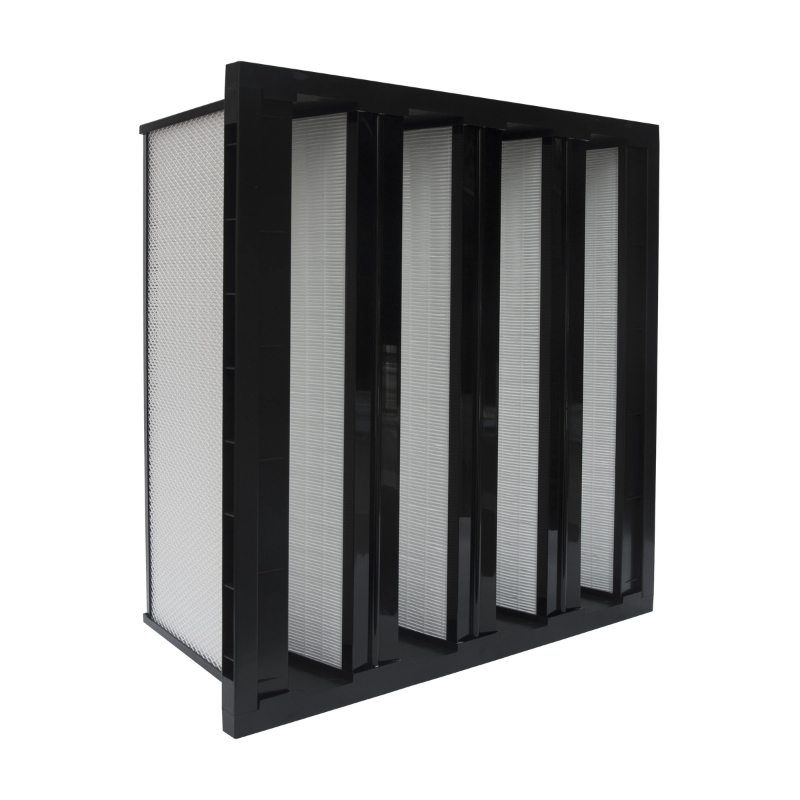
Pocket filters should be replaced based on actual operating condition, not simply on a calendar schedule. Specifically, replace the filter when any of the following occurs: it reaches the approved final pressure drop for that model at the specified airflow; the filter media is damaged or wet; or it can no longer maintain the required system airflow. A calendar interval is useful for scheduling inspections, but it cannot tell you how much dust a particular filter has actually collected. The correct replacement limit should be determined from the filter model, the fan and AHU design, and the site maintenance plan.
Pocket filters are commonly used as medium-efficiency stages in air-handling units (AHUs). KLC's F7/F8/F9 performance guide provides model examples and pressure-drop curves that can serve as a starting point for selection, but the final resistance limit should still be confirmed for the exact filter supplied. In addition, the older F7/F8/F9 labels should not be treated as a direct one-to-one conversion to ISO 16890 ePM ratings.
Filter pressure drop is the static pressure upstream minus downstream of the filter bank. Measure with the AHU in a consistent operating mode and record the airflow or fan speed alongside the reading. Pressure drop rises with airflow even if the filter has not become dirtier, so a reading after a fan-speed change is not directly comparable with last month’s value.
|
Record at each check |
Why it matters |
|
Date, AHU and filter-bank ID |
Keeps the trend tied to the right equipment. |
|
Filter model, grade and installation date |
Prevents mixed filters or replacement dates from distorting the trend. |
|
Upstream and downstream static pressure |
Supports a repeatable pressure-drop calculation. |
|
Airflow, fan speed or control mode |
Explains pressure changes caused by operating conditions. |
|
Visible condition |
Catches tears, collapsed pockets, moisture, and poor seating that pressure alone may miss. |
|
Approved final resistance |
Makes the replacement decision auditable. |
The ASHRAE Handbook chapter on particulate air cleaners identifies particle-removal efficiency, resistance to airflow, service life, and life-cycle cost as key filter characteristics. Resistance is defined at a given face velocity; that operating condition is essential to a fair comparison.
Check for physical failure first. Replace a torn, collapsed, badly seated, or wet filter according to site procedure even if the pressure drop is below the nominal limit.
Confirm the reading. Check gauge zero, tubing, pressure taps, and airflow setting. A blocked tap can mimic a sudden change.
Compare with the approved limit. Use the final pressure drop for the actual model and the AHU’s design constraints. Do not borrow a limit from a different filter depth or vendor.
Look at the trend. A gradual rise is typical of dust loading. A sudden jump may indicate a dust event, water exposure, or a control change. A sudden drop can indicate bypass, a torn pocket, or reduced airflow.
Plan the change safely. Follow shutdown, containment, and disposal rules for the material collected. Record the new filter’s clean baseline at the normal operating point.
The pressure reading is therefore a decision input, not the whole decision. If downstream cleanliness deteriorates while pressure drop falls, investigate for a torn pocket or air bypass rather than celebrating a “low-resistance” filter.

A fixed interval may be useful for stocking and inspection planning, but actual loading depends on outdoor air quality, operating hours, upstream prefilters, process dust, and humidity. A site with heavy particulate loading may reach its limit early; another may not. The ISO 16890 overview also notes that laboratory classification results alone do not predict service life in a real installation.
Do not assume it is washable. Most fine-fiber pocket filters are specified as replaceable elements. Washing may damage the media or its structure; follow the exact manufacturer’s instructions.
Airflow may have increased because the upstream restriction was removed. Check flow or fan speed before comparing the pocket filter’s reading with the old baseline.
Request the model-specific efficiency classification, rated-flow pressure drop, pressure-drop curve, recommended final resistance, dimensions, and airflow direction. Use these with the AHU schedule to set the site replacement trigger.
KLC’s pocket-filter range and performance guide provide the next step for comparing available sizes and grades.
• ASHRAE Handbook — Air cleaners for particulate contaminants
• ISO 16890-1:2016 — General ventilation filter classification



 IPv6 network supported