Global cleanroom air shower standards require jet velocities of ≥25m/s (GB/T 25915), H14 HEPA filtration (ISO 14644-14), and dual-door electronic interlocks. While US FED-STD-209E is officially withdrawn, buyers still use its cleanroom classifications alongside EU CE and ISO harmonized directives.
This article provides a rigorous, multi-regional comparison of Chinese GB/T 25915, international ISO 14644, and legacy US FED-STD-209E standards for air showers, detailing export compliance and mechanical specifications. B2B procurement managers, cleanroom system integrators, and export compliance engineers navigating global cleanroom installations should read this guide.
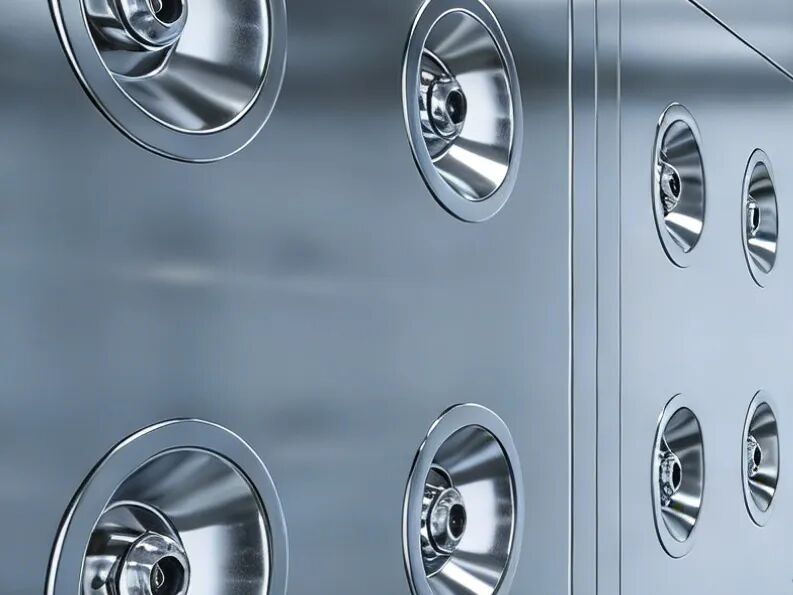
Cleanroom air showers serve as the primary physical barrier between unclassified changing rooms and highly controlled clean environments. By utilizing high-velocity, HEPA-filtered air nozzles, these systems physically dislodge and sweep away particulates from operators’ clothing and equipment. However, as cleanroom construction supply chains have globalized, B2B buyers frequently encounter conflicting engineering standards.
Three primary standards govern the design, safety, and performance of cleanroom air showers globally:
China GB/T 25915 (and GB 50073): China’s national standards are highly detailed regarding structural specifications, electrical safety, and aerodynamic output. GB/T 25915 is heavily aligned with ISO 14644 but introduces specific, legally binding domestic testing and manufacturing protocols for air showers.
ISO 14644 & IEST-RP-CC002.4: The International Organization for Standardization (ISO) defines cleanroom air cleanliness, while the Institute of Environmental Sciences and Technology (IEST) publishes the definitive recommended practice (IEST-RP-CC002.4) that governs air shower engineering, nozzle configuration, and testing methodologies globally.
US FED-STD-209E: Although officially retired by the United States General Services Administration in 2001 and replaced by ISO 14644, FED-STD-209E remains deeply ingrained in global B2B procurement. Many engineers in the Americas and parts of Asia still specify “Class 100” (equivalent to ISO 5) or “Class 10,000” (equivalent to ISO 7) and expect air showers to be tested against legacy Federal Standard metrics.
When procuring air showers for cross-border projects, understanding the minor differences in standard specifications is essential to avoid compliance failures during facility validation.
|
Technical Parameter |
China GB/T 25915 / GB 50073 |
ISO 14644 / IEST-RP-CC002.4 |
Legacy US FED-STD-209E |
|
Minimum Air Jet Velocity |
≥25m/s at nozzle face |
20-25m/s (4000–5000 FPM) |
≥20.3m/s(4000 FPM) |
|
Blowing Cycle Duration |
10–15 seconds (adjustable) |
10–20 seconds (factory default 15s) |
15 seconds (fixed default) |
|
Recirculating Filter Grade |
Primary Pre-filter + H13 HEPA |
H14 HEPA (99.995% @ 0.3 μm) |
99.97% or 99.99% HEPA |
|
Door Interlocking System |
Mandatory electronic/photoelectric |
Mandatory mechanical or electronic |
Mandatory electronic/pneumatic |
|
Self-Purification Time |
≤60 seconds |
Under 60 seconds (typically 45s) |
Not explicitly defined |
|
Noise Level Limit |
≤75dBA(during blowing) |
≤80dBA(during blowing) |
≤80dBA(during blowing) |
|
Casing Structural Material |
SUS304 or epoxy-coated steel |
Permissive (stainless/coated steel) |
Steel, stainless steel, or plastic |
To successfully import and install air showers across different international markets, B2B buyers must verify specific regulatory markings:
• European Union (EU) Market: Air showers exported to the European Economic Area must carry the CE Mark. This requires compliance with three harmonized directives:
Low Voltage Directive (LVD) 2014/35/EU: Covers electrical components, motors, and wiring safety.
Machinery Directive (MD) 2006/42/EC: Covers moving parts, such as automatic sliding doors and blowers.
Electromagnetic Compatibility (EMC) Directive 2014/30/EU: Ensures the air shower’s electronics do not interfere with other cleanroom equipment.
• North American Market: US and Canadian buyers frequently require compliance with UL 508A (for the electrical control panel) and NFPA 79 (Electrical Standard for Industrial Machinery).
• Chinese and Asian Markets: Projects must conform to GB 50073 (Cleanroom Design Code) and pass local QA inspection prior to factory startup.
As a premier B2B cleanroom equipment supplier, KLC designs its air showers to simultaneously meet GB, ISO/IEST, and US legacy requirements, simplifying compliance for global projects.
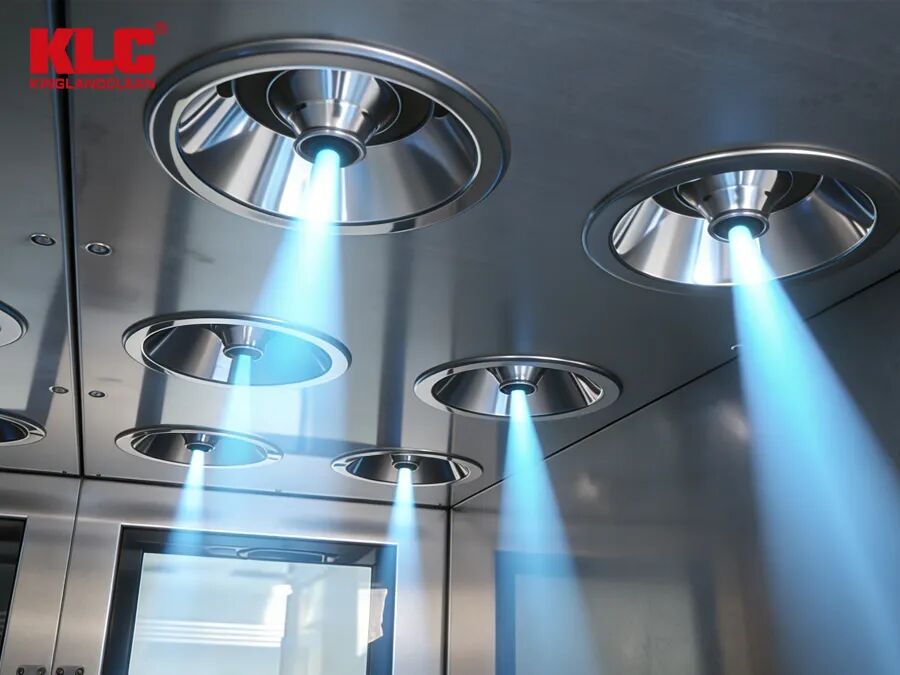
• Aerodynamic Power: Every KLC air shower is equipped with high-pressure, double-suction centrifugal fans delivering air speeds of ≥25m/s to 30m/s at the nozzle face, exceeding both GB/T 25915 and North American IEST minimums.
• Filtration Efficiency: Features standard multi-stage filtration consisting of washable nylon/synthetic pre-filters and premium, gel-sealed H14-grade HEPA filters verified to perform at 99.995% efficiency for 0.3 μm particulates.
• Advanced Control Systems: Equipped with user-friendly PLC controllers featuring programmable voice prompts, adjustable blowing times (0–99 seconds), and high-reliability electronic interlocks that prevent cross-contamination.
• Global Certifications: KLC air showers are fully CE-certified, meeting all EU LVD, MD, and EMC requirements, and are available with UL-compliant electrical configurations for the North American market.
GB/T 25915 is China’s national translation of the international ISO 14644 standard. While they are technically harmonized regarding cleanroom classifications (such as Class 5 or Class 7), GB/T 25915 is paired with localized Chinese engineering codes, such as GB 50073 and GB 50591. These domestic codes mandate specific structural testing, strict electrical safety requirements, and higher minimum air jet velocities
A minimum velocity of 25 m/s (approx. 5000 FPM) is required because physical testing has demonstrated that lower velocities fail to break the electrostatic and boundary-layer forces holding fine dust particles to clothing fibers. At 25 m/s or higher, the kinetic energy of the air jet is sufficient to flap clothing fabric violently. This physical agitation is necessary to shake loose sub-micron particles, skin flakes, and hair from the operator’s garments so they can be captured by the return air grilles.
Officially, FED-STD-209E was formally canceled in 2001 and is no longer recognized by regulatory bodies like the FDA or international standards organizations. However, in practice, many legacy cleanroom designs, B2B procurement documents, and engineering blueprints in the United States and global semiconductor supply chains still use the FED-STD-209E terminology (e.g., “Class 100” instead of “ISO Class 5”). Modern air showers designed to ISO 14644 standards are fully compatible with and easily surpass legacy FED-STD-209E expectations.
For an air shower to achieve CE certification, it must satisfy three main directives. The Low Voltage Directive (LVD) 2014/35/EU governs electrical insulation, grounding, and wiring safety. The Machinery Directive (MD) 2006/42/EC regulates mechanical safety, ensuring that moving parts like automatic doors do not pose a pinch hazard. The Electromagnetic Compatibility (EMC) Directive 2014/30/EU guarantees that the air shower does not emit electromagnetic noise that could interfere with sensitive laboratory or semiconductor equipment.
Yes, a high-quality air shower can meet both standards if designed correctly. The US FDA (relying on IEST recommended practices) and the EU GMP (relying on ISO 14644) both mandate physical separation, double-door interlocking, and HEPA-filtered recirculating air. To satisfy both regulatory frameworks, the air shower must utilize H14-grade HEPA filters, maintain a minimum air velocity of 25 m/s, use non-porous SUS 304 stainless steel, and feature an electronic interlock system that prevents both doors from being opened simultaneously.
An air shower must use a two-stage filtration system. The first stage is a pre-filter (G4 or F7 grade) designed to capture large lint, fibers, and hair. The second stage must be a terminal HEPA filter. According to international cleanroom standards, the HEPA filter must be at least H13 grade (99.95% efficiency), though industry leaders like KLC utilize H14-grade HEPA filters (99.995% efficiency @ 0.3 μm) to provide a higher safety margin and ensure that recirculated air is completely particle-free.
For safety reasons, the electronic door interlocks must have a fail-safe default setting. In the event of a total power failure or if the emergency stop button is pressed, the electromagnetic locks must immediately de-energize. This unlocks both doors simultaneously, allowing operators to escape from either side of the air shower in compliance with international fire safety and emergency exit regulations.
Self-purification time is the time required for the air shower’s internal air volume to return to its baseline cleanliness level after an operator exits. During a cycle, dust and fibers are dislodged into the air cabinet. If the next operator enters immediately before this dust is filtered out, they will step into a cloud of suspended particulates. Standard codes require the self-purification cycle to clear 99% of suspended dust within 60 seconds, which is achieved through high-frequency air changes inside the air shower chamber.
The G4 pre-filters are high-use components and should be cleaned or replaced every 1 to 3 months, depending on personnel traffic. The primary H14 HEPA filter is protected by these pre-filters and operates in a relatively clean recirculating loop, typically lasting between 2 to 5 years. Replacement of the HEPA filter should be triggered when the air velocity falls below the critical 20 m/s threshold or when a PAO aerosol challenge test reveals a leak in the filter media.
Every air shower manufactured by KLC is subjected to a comprehensive factory acceptance testing (FAT) protocol in our Guangzhou testing facility. This includes verifying air velocity at all nozzles, testing door interlock logic, executing electrical dielectric strength tests, and performing a PAO filter integrity scan. We provide complete FAT documentation packages, CE certificates of conformity, and electrical schematics with every shipment to ensure smooth customs clearance and rapid on-site commissioning.
Procuring cleanroom equipment for global facilities requires careful attention to regional standards. Choosing an air shower that complies with China’s GB/T 25915, ISO 14644, and legacy FED-STD-209E ensures seamless regulatory compliance and reliable contamination control. KLC’s CE-marked, high-velocity air showers offer B2B buyers a reliable, globally certified solution for demanding cleanroom environments.
Consult KLC’s engineering experts to select the right air shower specifications for your facility at KLC International.



 IPv6 network supported