Keywords: V-bank filter AHU, V-bank HEPA filter manufacturer, compact air filter energy saving
A compact V-bank filter achieves F7–F9 efficiency with lower pressure drop by arranging pleated media packs in a V-shaped geometry. This configuration multiplies the effective surface area, lowering media face velocity and aerodynamic resistance while maintaining high dust-holding capacity in restricted Air Handling Unit (AHU) footprints.
This article examines the aerodynamic and structural principles of V-bank filters, compares their technical performance with traditional pocket filters, and outlines specific integration guidelines for industrial Air Handling Units (AHUs). This comprehensive technical guide is written for HVAC system designers, cleanroom facility managers, and B2B procurement officers aiming to achieve sustainable energy savings in commercial and industrial air filtration.
In traditional flat-panel air filters, the filtration surface area is strictly limited by the physical dimensions of the duct or the filter mounting frame. To achieve higher particulate filtration efficiency (such as F7, F8, or F9 grades), denser filter media must be utilized. This increased density inherently limits airflow, creating high initial resistance (pressure drop) which requires the AHU’s supply fan to consume significantly more electrical energy.
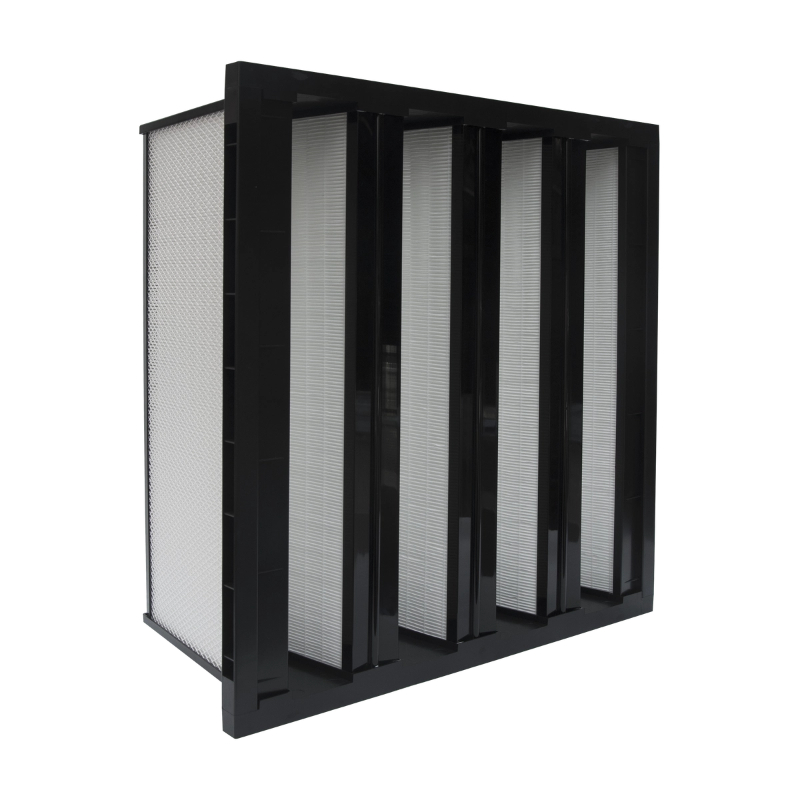
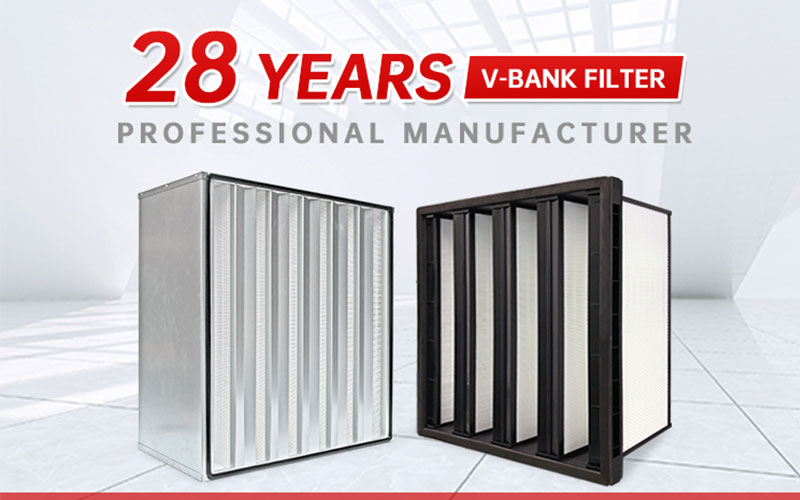
The V-bank geometry—sometimes referred to as a header, compact, or rigid multi-dihedral filter—circumvents this physical limitation through advanced geometry. By mounting several mini-pleated media packs (typically arranged in 2V, 3V, 4V, or 5V configurations) at acute angles inside a rigid, deep box frame, the effective filtration area is expanded dramatically.
To understand the mathematical and physical basis of this advantage, we analyze the relationship between volumetric airflow (Q), effective filtration surface area (A), and media face velocity (Vm):
Vm = Q / A
When the effective filtration area (A) is multiplied by a factor of three to five within the same mounting face dimensions, the velocity at which air passes through the actual filter media (Vm) drops proportionally. According to Darcy’s Law for fluid flow through porous media, the pressure drop (ΔP) across a clean filter is directly proportional to this media face velocity.
By drastically reducing Vm, the V-bank filter maintains a remarkably low initial pressure drop, often lower than 90 Pa even at high nominal airflows of 3,400 m³/h (2,000 CFM). This reduction in resistance leads directly to lower fan motor power draw, while the larger surface area distributes captured dust more thinly, preventing rapid cake build-up and doubling the service life of the filter.
|
Technical Parameter |
KLC Compact V-Bank Filter (F8 Grade) |
Standard Pocket/Bag Filter (F8 Grade) |
Operational & Financial Impact |
|
Nominal Airflow |
3,400 m³/h (2,000 CFM) |
3,400 m³/h (2,000 CFM) |
Standard testing baseline. |
|
Effective Media Area |
18.5 m² |
9.2 m² |
Double the media area reduces physical stress on fibers. |
|
Initial Pressure Drop |
95 Pa |
145 Pa |
34.5% reduction in initial resistance. |
|
Final Recommended Resistance |
300 Pa |
250 Pa |
V-bank withstands higher pressure without collapsing. |
|
Dust Holding Capacity (DHC) |
650 g |
320 g |
Over 100% increase in dust storage capability. |
|
Average Lifespan |
18–24 Months |
8–12 Months |
Halves the replacement frequency and labor costs. |
|
Dimensions (W x H x D) |
610 × 610 × 292 mm |
592 × 592 × 600 mm |
V-bank is over 50% shorter, saving AHU footprint. |
|
Casing & Frame Rigidity |
Rigid ABS or Galvanized Steel Frame |
Flexible Header with synthetic pockets |
V-bank eliminates media flapping and dust bypass. |
|
Estimated Annual Energy Cost |
$185 USD / unit / year |
$295 USD / unit / year |
Saves approx. $110 USD per filter slot annually. |
When integrating V-bank filters into an Air Handling Unit (AHU), designers must evaluate several critical physical and aerodynamic constraints:
Airflow Velocity and Capacity: A standard 610 × 610 × 292 mm (24 × 24 × 12 inches) compact V-bank filter is optimized for air volumes ranging from 2,500 m³/h to 4,000 m³/h. Operating above this range causes turbulence within the “V” channels, leading to a steep, non-linear rise in pressure drop.
External Static Pressure (ESP): Designers must ensure that the supply fan can overcome the cumulative initial resistance of all filter stages (primary, medium, terminal) while maintaining design airflow. Selecting low-resistance V-bank filters preserves static pressure, permitting the use of smaller, less noisy fan motors.
Physical Footprint and Depth: Modern compact AHUs place a premium on cabinet length. Pocket filters require up to 600–900 mm of depth to allow the bags to inflate fully. In contrast, V-bank filters have a fixed, rigid depth of just 292 mm, shortening the entire AHU cabinet, which reduces cleanroom structural costs.
Frame Compatibility: KLC V-bank filters are equipped with a 25 mm or 20 mm header flange, making them fully backward-compatible with standard universal holding frames and front- or side-loading filter tracks in existing AHU designs.
We highly recommend installing a high-precision differential pressure gauge, such as a Magnehelic gauge, across each filter stage in the AHU. - Baseline Recording: Note the initial pressure drop when the filter is brand new and the fan is running at design volumetric airflow. For a KLC F8 V-bank filter, this is typically 90–100 Pa. - Monitored Progression: As particulates accumulate, the resistance will rise slowly. - Economic Limit: The economic replacement limit is reached at approximately 2.5 times the initial resistance, typically around 250–300 Pa. - Energy Cost Penalty: Beyond 300 Pa, the fan power curve rises sharply. The cost of the additional electrical power required to force air through the clogged filter quickly exceeds the amortized cost of purchasing and installing a new filter element.
• Efficiency Ratings: Standard grades available in F7 (ePM2.5 70%), F8 (ePM1 70%), and F9 (ePM1 85%) conforming to EN1822 and ISO 16890 standards.
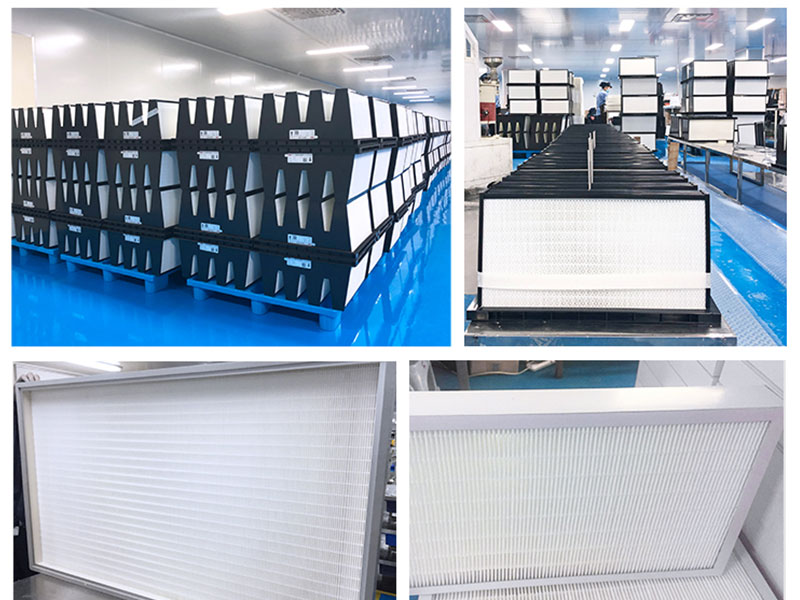
• Media Formulation: High-loft, wet-laid micro-glass fiber media. The paper-thin media is pleated with computerized hot-melt separators to maintain precise pleat spacing and eliminate structural dead zones.
• Frame Configurations: Customers can specify heavy-duty galvanized iron (GI), anodized aluminum alloy, or high-impact ABS plastic. The ABS plastic model is fully incinerable, simplifying hazardous waste disposal.
• Sealant and Gasket Integrity: Continuous polyurethane sealant bonds the media packs securely to the frame, ensuring zero bypass. Closed-cell neoprene or continuous polyurethane gaskets are applied to the header flange to guarantee airtight mounting.
Yes, KLC V-bank filters are designed with standard 20mm or 25mm header flanges that seamlessly fit into the same universal holding frames used for pocket filters. Retrofitting your system with V-bank filters requires no structural modifications to the AHU, immediately saving space and cutting down on initial airflow resistance.
A rapid spike in pressure drop usually indicates an inadequate pre-filtration stage. If the primary G4-grade pre-filter is torn, bypassed, or saturated, large atmospheric dust particles will settle directly onto the fine V-bank micro-glass media, sealing its micro-pores prematurely. Regularly maintaining the pre-filters is essential to ensuring a 24-month V-bank service life.
Wet-laid micro-glass fiber maintains highly stable mechanical filtration efficiency throughout its operational life. In contrast, many synthetic polymer medias rely on an electrostatic charge (electret) to achieve F7–F9 ratings. Once this charge dissipates due to humidity and fine dust loading, the filtration efficiency of synthetic media can degrade significantly, whereas glass fiber remains consistent.
A Magnehelic gauge measures the real-time pressure differential across the filter bank. Rather than guessing replacement schedules, operators can replace filters at the precise thermodynamic sweet spot (typically 250–300 Pa for F8 grades). This prevents excessive fan power draw while avoiding the premature replacement of perfectly clean filters.
These numbers represent the number of “V” shapes (dihedrals) packed into the standard 610mm width frame. A 4V configuration is the industrial standard, balancing large filtration surface area with spacious air channels. A 5V configuration offers even more media area but may slightly restrict airflow at extremely high face velocities, while a 3V configuration is optimized for high-dust load applications.
Absolutely. KLC uses specialized, high-impact virgin ABS plastic with glass-fiber reinforcement. This material is structurally rated for continuous air velocities up to 3.0 m/s and differential pressures exceeding 1000 Pa. Additionally, ABS is entirely rust-proof and corrosion-resistant, making it perfect for humid cleanroom environments.
No, high-efficiency F7–F9 V-bank filters cannot be washed or cleaned. The micro-glass fiber matrix relies on delicate mechanical trapping mechanisms that are permanently destroyed by water, detergents, or high-pressure compressed air. Attempting to clean these filters will cause fiber tearing, leading to catastrophic dust bypass.
KLC V-bank filters directly reduce the energy consumption of HVAC systems by maintaining a low average pressure drop over their lifespan. Because HVAC systems account for up to 40% of a facility’s energy use, upgrading to energy-saving V-bank filters helps earn points under the Energy and Atmosphere (EA) category of LEED and other green building frameworks.
Optimizing cleanroom and commercial HVAC operations requires a balance between filtration efficiency and operational energy costs. By transitioning from traditional, high-resistance pocket filters to advanced compact V-bank configurations, facilities can achieve double-digit reductions in fan power draw while doubling dust-holding capacity. This aerodynamic upgrade reduces the total cost of ownership and shortens replacement cycles. For customized cleanroom HVAC solutions and technical assistance, explore the comprehensive filter range at KLC International.



 IPv6 network supported